
LECTURE 3: Actuators, Encoders, Relays and Switches.
Actuators:
An actuator is the device that brings about the mechanical movements required for any physical process in the factory. Internally, actuators can be broken down into two separate modules: the signal amplifier and the transducer. The amplifier converts the low power control signal into a high power signal that is fed into the transducer, which actually converts the amplified control signal into the required form of energy.
Figure 3.1. The Structure of an actuator
Examples:
Electric motors, Servo-controlled valves, pneumatic drives, hydraulic drives...
Electric Motors:
Everyone is familiar with DC and AC electric motors. A brief review of these motors (components, performance characteristics, and applications) will be given before discussing the more interesting stepper- and servo-motors.
All electric motors use electromagnetic induction to generate a force on a rotational element called the rotor. The moment to rotate the rotor is created due to the interaction of magnetic fields generated by the rotor, and the part surrounding it, which is fixed, and called the stator.
In DC motors, the electromagnetic field in both, the rotor as well as the stator are generated by passing the DC current through the electric wire coils in them. The orientation of the coils with respect to each other, and a commutator (which essentially changes the direction of the electromagnetic field in the rotor as the motor rotates) ensures that the interacting fields maintain a torque.
In AC motors, only the stator has coils through which current passes. This current creates an alternating electromagnetic field, which induces an alternating current in the rotor. The interaction of the two electromagnetic fields is used to create the driving torque.
Figures 3.2-3.4 summarize the torque and speed characteristics of typical motor types, and some common applications.

Figure 3.2. DC motor types and applications
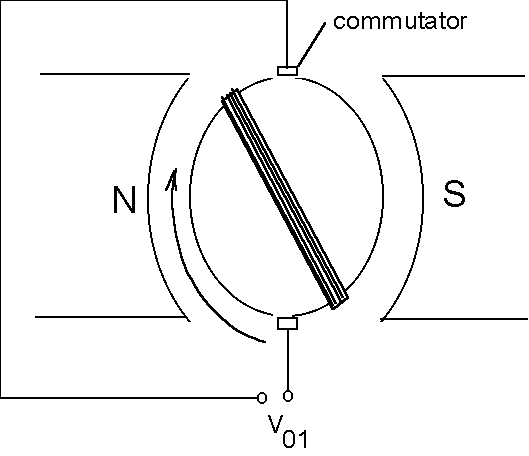
Figure 3.3 Characteristics of DC motors
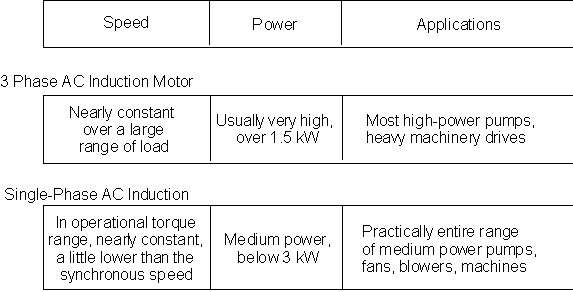
Figure 3.4 AC motor summary
Motor Controls:
Most common motor applications are not sensitive enough to require very tight accuracy of speed or control over the motion. However, from the viewpoint of manufacturing and production automation, such considerations are critical. For instance, any robot actuator requires that its motion be governable in positioning, velocity and acceleration with very high accuracy. Similarly, most NC machines have all their actuators controlled to provide positioning accuracy that is one order of magnitude less than the required accuracy of the part being manufactured. Considering that the typical tolerance on steel parts is 0.01" or less, this means that the machine controller has to be able to move the machine table to within one-thousandths of an inch of the programmed point. How are such precise motions generated?
The two most common motor types used in such applications are stepper motors, and servo-driven motors (or simply, servomotors).
Stepper Motors:
These are most directly adaptable for digital controlling methods. The stepper motor is driven by feeding it a stream of electric pulses. Each pulse makes the motor rotate by a fixed angle (e.g. 1.8º). We consider a simple type of stepper motors. The rotor is a permanent magnet, configured so as to have a series of equally spaced (angularly) sets of poles along the circumference. The stator has a corresponding number of coils. For a required motion, only one of the stator coils is activated, causing the rotor to align its poles in opposition to the electromagnetic poles of the energized coil.
Further, by activating a combination of coils, the selection of the right combination gives further resolution in the steps taken by the motor. Yet another method used by stepper motor drive units is application of pulses of different voltages to different coils. By proper selection of the voltage levels applied, smaller steps can be produced, thus making the motor more precise.
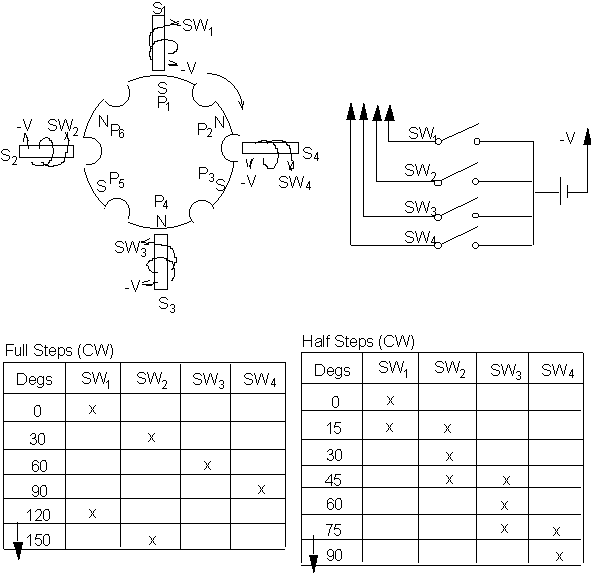 Figure 3.5. The principle of the Stepper Motor
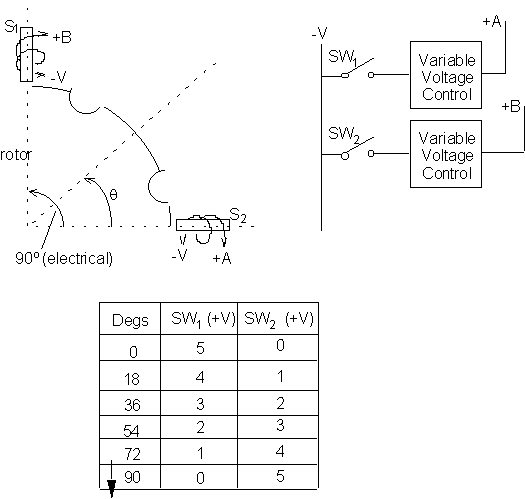
Figure 3.6. Microstepping Controls for Stepper motors
Stepper motors can only provide low torques. They are commonly used in laser positioning, pen positioning, disc and CDROM drives, robots, positioning tables etc.
Servo Motors:
When higher torque is needed with precise control, servo motors are the best option. They provide high torque at all speeds, versatile speed control, very low drift (and therefore high repeatability), ability to reverse directions rapidly and smoothly etc. Servomotors may be AC or DC. In fact, practically any AC or DC motor can be converted to a servomotor by regulating it electronically, and using position and force feedbacks. Since the servomotors are driven through this electronic control, they are also easily interfaced with microprocessors or other high level controlling devices quite easily. The digital signal from the computer is converted to its equivalent analog level via an electronic DA converter.
Hydraulic Actuators:
Hydraulic systems are often used for driving high-power machine tools and industrial robots. They can deliver high power and forces. They also suffer from maintenance problems (e.g. leakage of the hydraulic fluid, dirt/contamination of fluid.) Hydraulic actuators may be linear, or rotary.
Example of linear actuators:
Applications?
Figure 3.7 shows the control system for a typical hydraulic rotary drive. the hydraulic power supply actually comprises of a pump, usually driven by a 3-phase electric motor. The pump may be a gear pump, or radial/axial displacement type. The functioning of the hydraulic motor itself is the opposite of the hydraulic pump. The servo control is exerted by applying a control voltage to a solenoid driven valve; the flow rate of oil through the valve is proportional to the voltage applied (itself proportional to the valve opening).
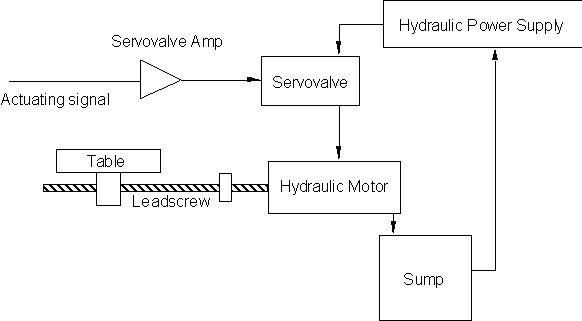
Figure 3.7. General structure of a hydraulic drive system
Pneumatic actuators:
Pneumatic actuators work, in principle, similar to hydraulic actuators. However, the most common pneumatic controls are linear actuators, which are basically a piston-cylinder assembly connected to a supply tube of compressed air. Since air is highly compressible, pneumatic drives are frequently not used for high force transmission, nor are much good for accurate position control. Typically, they are used for fixed motion of small objects that are very common on assembly and transfer lines.
Discrete control of pneumatic systems:
Many operations on automation lines require steps like feeding of a part into a fixture, pushing the part on/off a conveyor (or between parallel conveyors, to change direction of travel), or transporting a part between several closely placed assembly or testing stations. Discrete pneumatic controls are ideally suited for such tasks. The position control is discrete, since the pneumatic system is selected so that the part motion is achieved by full travel of the piston. That is, the piston, on actuation, extends fully, and on retraction, returns back to its zero position. Figure 3.8 shows an example configuration for contactor testing:
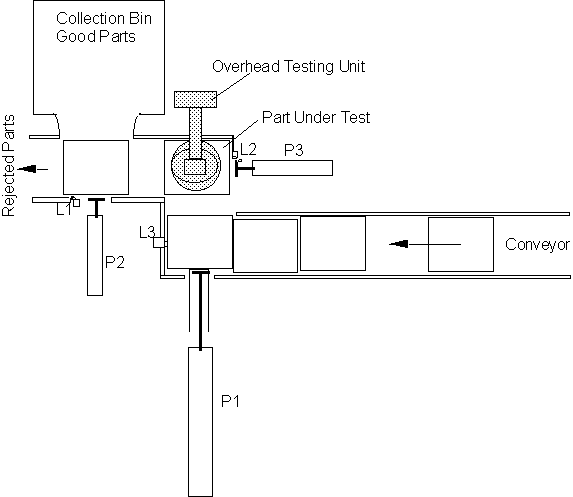
Figure 3.8. An application of pneumatic actuators for testing
When the overhead testing machine is testing a part, all three pistons are retracted (P1, P2, and P3 are OFF). As soon as testing is over, the testing machine sends two signals to the pneumatic relay circuit: the first one indicates that the testing is complete, and the second one indicates if part is good. The first signal is used to open the relay valve for P3, which unloads the part to the out-chute. Full extension of P3 also triggers a limit switch (L1) on the chute. If the limit switch as well as the "part-is-good" signal are ON, P2 is activated, pushing the part into the collection bin. P2 then retracts. Full retraction of P3 triggers another limit switch, L2. Whenever a part is waiting on the in-chute, limit switch L3 is activated. On activation of L3 and L2, the relay valve for P1 is opened, pushing the new part onto the testing fixture.
Further on in the course, we shall study discrete control relay circuits in more detail.
Other Actuators:
Fuel-based engines.
Examples ?
Actuator characteristics:
The three major characteristics of actuators are accuracy, precision, and reliability. The definitions of these parameters is consistent with the corresponding definitions given earlier for sensors.
Switches
The most fundamental control of any equipment is the ability to turn it on/off. The easiest way to do this is using switches. Figure 3.9 shows typical configurations of switches.
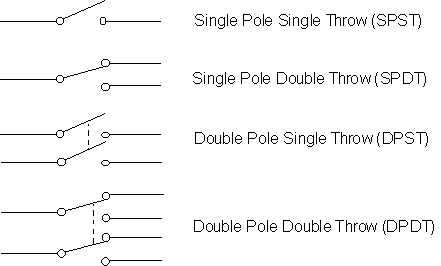
Figure 3.9. Configurations of switches
Relays
Although switches are universally used, they have their disadvantages. The biggest one is that they have to be manually (physically) turned on/off. Also, they are relatively large and occupy more space than the comparably rated alternative: relays. Relays are basically switches, which are turned on/off by application of a low voltage across the relay terminals. They are universally found in automatic control applications, since they can control equipment directly through electric signals instead of requiring physical operation. Figure 3.10 shows the structure of a simple relay. Relays may be Normally Open, or Normally Closed. In the former, the contacts are connected only when the actuation terminals are energized. In Normally Closed relays, the device is connected to the power supply when the relay actuation terminals are not connected. Relays with high current capacity (over 40Amps) are called contactors.
What type of relay does the figure show ?
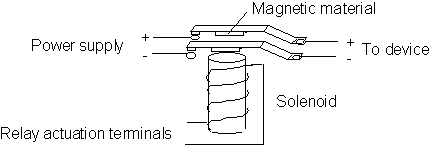
Figure 3.10. Schematic of a relay
Encoders
Encoders are sensors used to detect position. They can be linear, or rotational. The problem with linear encoders is that they have to travel the entire length of their range. Linear encoders, therefore, are long and expensive. Rotational encoders, on the other hand, are small and relatively cheap and less unwieldy. They are very common in many devices. The principle used in most encoders (linear or rotational) is the same: an optical device. We shall study two types of rotational encoders briefly.
Figure 3.12 shows an incremental encoder. The disc has three strips of opaque material which have been cut to form a binary counting pattern. At any stage, depending on the output of the three optical cells, the position of the encoder can be read off, as shown in the figure.
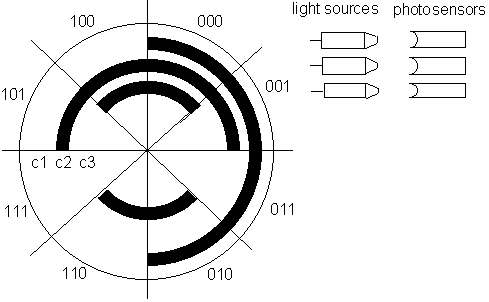
Figure 3.11. A Coded-Pattern encoder
An incremental encoder uses the same physical principle. However, since in this case there is no necessity to maintain absolute position, a simple pattern of evenly spaced opaque strips along the circumference of the disc suffice. The incremental movement (rotational) is determined by the number of cycles the photocell goes ON-OFF during the movement.
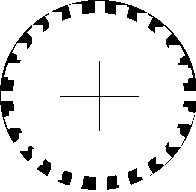
Figure 3.12. An incremental encoder
By using two photocells instead of one, and by judiciously placing the two cells 90º out of phase with each other, the direction of movement of the encoder can easily be determined, as shown in the following two figures.
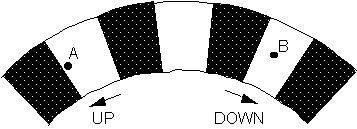
Figure 3.13. Using two sensors with 90º phase shift to sense direction
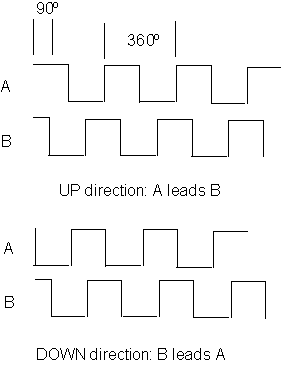
Figure 3.14. Direction sensing with two sensors in an encoder