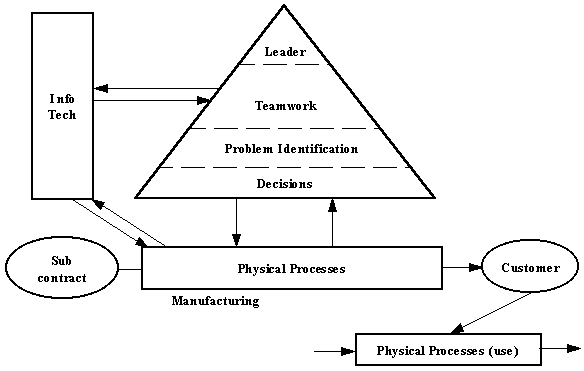
In this set of notes, we shall look at some of the interesting aspects of how the modern manufacturing system has evolved (and why), in terms of the working conditions and the job management of the personnel. The role of humans in manufacturing systems has changed partly due to a better understanding of human factors, partly due to better understanding of psychological aspects that lead to better motivated and productive teams of people, and partly due to the changing structure of the manufacturing systems itself, in terms of automation and organization.
Any manufacturing system works through the integration of four components: physical processes (e.g. machines, tools, hard assets etc.), decision structures (mechanisms and criteria for decision making, e.g. scheduling, forecasting models, inventory control policies etc.), information technology (data/information stored about all aspects of the system and the supporting technology to maintain the data), and humans. This integration is captured in the following figure:
When dealing with human aspects of organization, or working, we need to understand some basic aspects of human behavior or capabilities. We shall only concentrate on aspects that relate to productivity, leadership, and motivation.
Most of these issues relate to how humans handle information. We shall loosely use Shannon's framework, and assume that information content is expressed in quantitative terms, using the unit of bits (one bit will represent an atomic unit of information). Further, information processing or communication will be measured in terms of bits/sec.
The figure below shows typical amount of information that is generated by the different sense organs for a typical human. Further, it shows, for each sense, how much data can consciously be processed by us.
|
Sense |
Sensory data rate |
Awareness data processing rate |
|
Sight |
10,000,000 |
40 |
|
Hearing |
100,000 |
30 |
|
Touch |
1,000,000 |
5 |
|
Taste |
1,000 |
1 |
|
Smell |
100,000 |
1 |
Clearly, our senses are overloading us with information, of which we are aware, or consciously notice only a small fraction.
Further, while the brain itself is capable of processing information at very high rates, we can only communicate with the external world (other people, devices like computers of typewriters, etc. at a relatively low rate.
How do we communicate large, complex amounts of information between people ? We must either spend a large amount of time, transferring the information at a low rate, OR, we must first organize the information into larger chunks, and communicate using these chunks instead of low level bits. We shall call these chunks of information Bits (with upper case B). The following figure shows how information is transferred between individuals using this type of information organization.
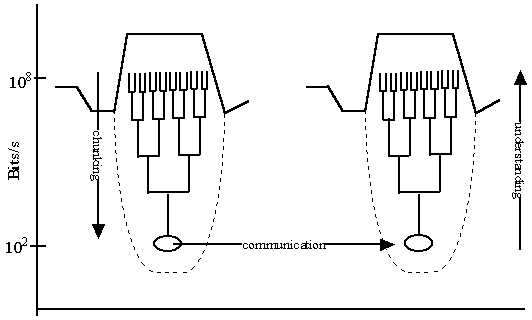
The above model shows that meaningful communication using Bits can only take place if both the people involved have the same hierarchical chunking structure existing in their brains.
What are some examples of this structure building ?
Language study: two people who know English can use the word "hamburger" to communicate about a complex food type.
Technical study (training): an engineer who says "JIT" to another communicates information to another that is sufficient to fill a book.
Clearly, if two people who work together do not have the same hierarchical structures of information built into their brains, communication will take a long time. Further, the likelihood of miscommunication is higher.
This therefore leads to the first conclusion about workforces: It is essential that the workforce has received the proper training; also, it is essential for terms used by the workforce to have the same meaning throughout the organization.
Another interesting observation about humans: our brain's capability to process data increases till the age of approximately 20 years, and then decreases (!) as shown below:
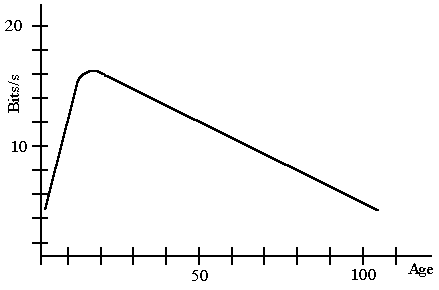
Notice that the units of information processing capability are in Bits: which means that with increasing age, a more efficient human will use higher level of chunking to process larger total amount of information. This highlights the second important directive about the workforce:
Continually train the workforce to enlarge their knowledge. This is the only way by which the aging human can still increase their efficiency of information handling and cope with increasingly complex job requirements.
One of the leading philosophers of quality in manufacturing, Prof Deming identified that 85% of the Quality problems in companies are related to poor organization and leadership. It is therefore important to understand that apart from process capabilities, the bigger factor controlling quality in manufacturing systems depends on the Operators' competence, Motivation, Flexibility and on the Personnel Stability at the organization.
Some of these factors are related to the management of employee competence. One way to build/develop competence is through encouragement and incentives for learning. The following attributes are commonly found in 'Learning Organizations':
The moral of the story: Introduce Organizational Learning in the manufacturing system. Mechanisms that allow this to be done include: On the job training, Learning about the whole manufacturing and product realization process, and Interacting with the customer to understand customer demands.
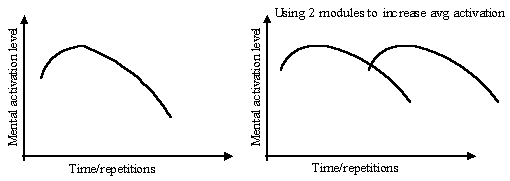
Further, mental activation should be kept high in order to avoid errors during the performance of tasks. The figure below shows typical level of mental activation with increasing number of repetitions of the same task. One possible method to maintain a high average mental activation state is to compose the manufacturing task into modules, and allow the workers to rotate between modules periodically, as shown in the second figure.
The following figure shows three separate aspects of human issues proposed by Kjellberg as constituents of a better working organization for manufacturing systems.
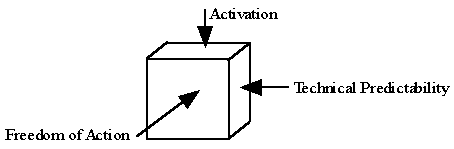
ACTIVATION, uses a physiological perspective, and refers to the amount of stimulation. It is related to:
level of activity
stress
ability to focus
vigilance
task variations
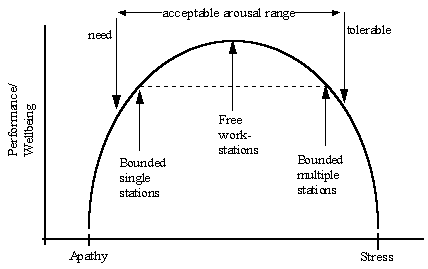
It must be noted that extreme activation is highly correlated to high stress, which may be disruptive. On the other hand, low activation leads to apathy, and eventually to lower feeling of well being, and lower performance levels. This is summarized in the graph below.
FREEDOM OF ACTION leads to the development of competence (due to added responsibility and decision making requirements). It is related to:
Increased authority
Responsibility
Increased capacity for improvement
The level of freedom of action increases as the nature of the job changes respectively from very low (reproductive work) to low (Rule-based decisions), to moderate (Goal oriented work) to very high (in Creative/Innovative work).
TECHNICAL PREDICTABILITY refers to the level of unpredictability that exists in the manufacturing system in which the human is operating. If the system is highly predictable in its behavior, then the work will not present a high level of challenge or stimulation to the worker. On the other hand, if the system is highly unpredictable, then very often the worker may not be able to cope with the demands. The optimum level of operation is somewhere between these two limits, when there is just sufficient unpredictability in the system to keep the work stimulating. This aspect is related to
attention
understanding
mental readiness
flexibility
creativity
The conclusion of the above findings and observations is changing the work organization of the modern manufacturing system. In the 80's, the organization was Functional, with groups being formed by specialization (e.g. Mechanical design dept, Production dept, Electronic Data processing Dept etc), with managers forming a traditional hierarchy. Further, the emphasis was on the functional specifications, and there was no clear concept of the customer or his demands during the normal operation of the system, except for the marketing/sales departments. However, in the 90's, there has been much emphasis on forming Cross-functional groups (called Teams), which work on specific goals or projects together. The emphasis is on coaching, teamwork, and continual on-the-job learning/training. There is continued and direct interaction with the customer for each project, and therefore the customers and their preferences are well-defined for each member of the team.
These notes are based on the IEEM513 lectures of Prof Gunnar Sohlenius during spring 1998. Part of the material is attributed to Prof Ann Kjellberg, who conducts research in this area at the Royal Institute of Technology, Sweden, KTH. Some material was translated from the original Swedish to English by me, using the online version of Skolverket's Lexin Swedish-English dictionary linked from the Web of Online Dictionaries site