What is Manufacturing
This course is about Computer-Aided Manufacturing. WE shall focus only on
a small subset of all manufactuirng activities. It is assumed that one hasa
reasonable background of basic manufacturing processes, how they operate,
what they can do, and what are their limits. The areas of design, manufacturing
and production control are often knitted together, and even more so today
due to the growing emphasis on concurrent engineering.
The figure below shows the basic roles of these activities.
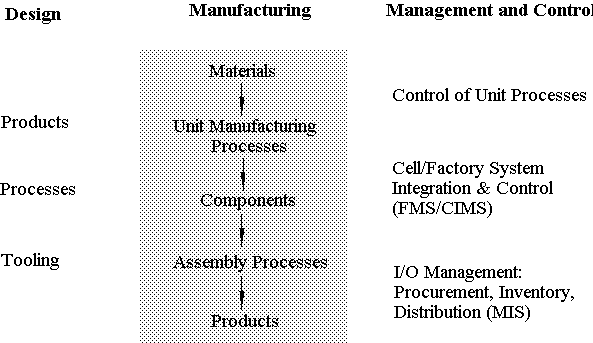
[source: K.-K Wang, Some emerging manufacturing processes for the 21st century,
Procs of the 3rd International Conference on Automation Technology
, July 1994, Taipei, Honorary Volume, p 17-23]
Most textbooks classify manufacturing activities as shown below:
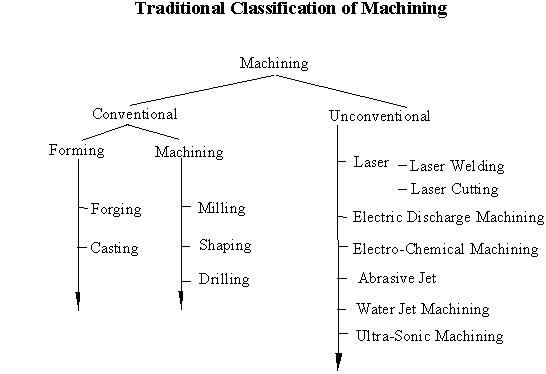
Prof Wang proposed that we look at these processes from a more fundamental
viewpoint -- the chemical or physical phenomena involved. Using htis scheme,
we can get a more 'timeless' classification:
-
Mass Change Processes involve the removal of material by mechanical,
electrical or chemical means.
Examples: Milling, Drilling, Grinding..., EDM, ECM...
-
Phase Change Processes produce a solid part from material originally
in liquid or vapour phase.
Examples: Casting of metals, Infiltration of composites, Injection
molding of polymers...
-
Structure Change Processes alter the material structure of a workpiece,
either in the workpiece bulk, or in a localized area such as its surface.
Examples: Case hardening, Heat treatment...
-
Deformation Processes alter the shape of a solid workpiece withut
altering its mass or composition.
Examples: Rolling, Forging, Sheet metal operations, drawing,
ironing...
-
Consolidation Processes combine materials such as particles, filaments,
or solid sections to form a part or component.
Examples: Powder Metallurgy, Ceramic molding, Polymer matrix
consolidation... Welding, Brazing...
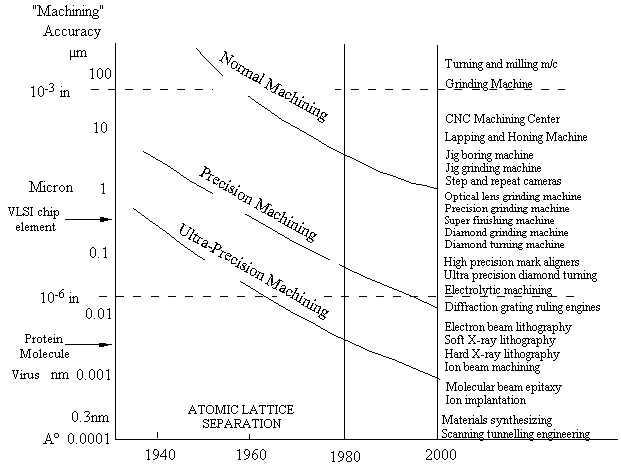
Finally, a fugure that shows roughly the state of the art -- the best surface
finish or accuracy that can be acheived by several of the common manufactuirng
processes that are used today. You may recall that some of the common microprocessors
now use features with geometry of apprximately 0.18 microns.
[Source: Norio Taniguchi, Current status in, and future trend of, Ultraprecision
Machining and Ultrafine materials processing, Annals of the CIRP,
vol 32/2, 1983, p 573-582]