Reference paper:
Tomas Varady, Ralph R Martin, Jordan Cox, "Reverse Engineering of Geometric Models -- an Introduction," Computer-Aided Design, v 29, n 4, 1997, p 255-268
Assignments:
[Daniel] [p 257 col 2] [Triangulation]: Laser scanners use two components, a laser source and a camera, to obtain the [x, y, z] coordinates of points on the surface using the principle of triangulation. How does this work ?
[Raymond] [p 258 col 2] [MRI] Magnetic Resonance Imaging is one method for scanning a surface. How does it work ? Does the technique restrict the type of materials that can be scanned ?
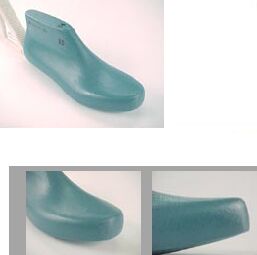
[Jennifer] [p 260-261] [Segmentation, Classification, Fitting] Notice that most shoe lasts have two sets of (nearly) sharp edges: (a) on the top, back side, and (b) the bottom surface outline. How will you use segmentation techniques, such as those used for classification, to automatically recognize these sharp edges from the point cloud data?
[Fujing] [p 263 col 2] [G1, G2, C1, C2] Explain, with simple examples, what is meant by the Cn continuity for curves, and Cn or Gn continuity for surfaces.
[Rasmus] [p 263-264] [Surface fitting] Given a set of points, depicting a complex surface
like a shoe last, it is not a good idea to try and find just one mathematical function
z = f(x, y) that will describe the entire shape. It is better to break the shape into
several smaller patches (i.e. collection of nearby scanned points) and find one function
for each of these patches. Simpler patches implies simpler functions. How should we
break-up all the points into such "regions" or "patches" ? One way is to first define
a network of curves (see figure 6 in the paper). Another is to somehow break down the
entire shape into some components which are meaningful, in terms of the design, or in terms
of the manufacturing (functional decomposition).
Given a point cloud describing a shoe last, how would you apply these techniques to
break it into patches ? Whic method do you think is more promising ?
[Cui] [p 264 col 1] [Surface Fairing, Surface energy] There are many references in papers and text-books about surface fairing. Give a brief explanation of what this is. Also, the paper mentions that apart from using least-squares fitting to fit a surface/curve to a set of points, other methods may be used that, for example, minimise the total energy of the resulting surface. What is surface energy ? How to compute it ? What is the physical meaning of this ?