
Due Date: Sat, Oct 5.
Q1. The following is a partial ER diagram for movies. The following information is known: Each movie is produced by one company, and has zero or more actors. Each actor has acted in one or more movies. Each company has produced one or more movies. Based on this, mark all the cardinality ratios, and all the participation constraints.
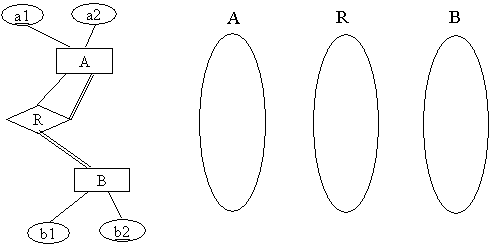
Q2. In the following ER diagram, the database currently has 3 unique entities of Entity type A, and 3 unique entities of Entity type B. Complete the picture of the entity sets such that your picture is consistent with the constraints given:
Q3. You are asked to design a database for the university Health Center (HC).
Given below is a description of some of the information.
The center has several staff, including Doctors, Nurses and Clerks.
Doctors may be general practitioners, or specialists in a particular area.
Each Doctor has a weekly schedule which describes when he/she will be present in the
HC - this is indicated by session (morning and/or afternoon) and day
(one or more days of the week).
The HC also keeps many medicines in its pharmacy. The inventory for the
medicines must keep track of the following information: Each medicine is
identified by its name. There can be many batches of each medicine, with
each batch having a unique expiry date, quantity in stock.
Patients come to the HC to consult the doctors. For each patient, the
name, HKID, and insurance policy details (insuring company, policy number,
expiration date) are stored. The following information about each
consultation is stored: Date and time, Doctor's comments, prescription
(medicine name and quantity).
Draw the ER diagram for the above information.
NOTE:
1. There are MANY different answers to this question, so I expect all of you will have different solutions.
2. There may be records of other information that I have not specified; state clearly what other information you think is necessary to make a "good" DB design. Include this in your ER Diagram.
In your ER diagram, make sure to include: